Quick Answer
A high tibial osteotomy reshapes the shinbone to shift weight off a worn side of the knee and keeps your own joint, while a partial knee replacement removes the worn area and fits an implant. Surgeons choose between them by looking at where the damage is, how advanced it is, leg alignment, knee motion, ligaments, age and activity level, and the final decision needs an in-person examination.
- Both operations are designed for arthritis limited to one part of the knee, but they work in opposite ways.
- Osteotomy is described for earlier-stage arthritis with a correctable alignment problem; partial replacement is for advanced arthritis confined to one compartment.
- Recovery from osteotomy is usually longer because the bone must heal, with several weeks on crutches.
- Pain relief after osteotomy is less predictable, but once healed there are no activity restrictions.
- Either path may lead to a total knee replacement later, and a partial replacement can be changed to a total replacement during the operation itself.
- Comparing costs means looking beyond the first quote to recovery time, follow-up and a possible future operation.
At 48, with a knee that aches on the inside after a long walk but still bends and straightens well, you may hear two very different suggestions from orthopaedic surgeons. One talks about a high tibial osteotomy: reshaping the shinbone and keeping your own knee. The other talks about a partial knee replacement: removing the worn part of the joint and fitting an implant. Both are aimed at arthritis on one side of the knee. Both are discussed most often with younger, active people, and in knee surgery "younger" does not mean your twenties. It usually means someone who is still working and active and has many years of use ahead for the knee. The American Academy of Orthopaedic Surgeons, for example, describes osteotomy as most effective in active patients under 60, so a 48-year-old sits well inside that group. Yet the two operations work in opposite ways, recover differently and leave you in different positions for the decades that follow.
Choosing between a high tibial osteotomy and a partial knee replacement is a surgeon's decision, made with you, after an examination and imaging. What we can do is explain the reasoning behind that decision in plain language: what each operation is designed to do, what surgeons weigh, how the months after surgery compare, what happens if a total knee replacement is needed later, and how the costs differ over time. Nothing here tells you which one suits your knee. It should, however, make the conversation with your surgeon much easier to follow.
Two Operations Built on Opposite Ideas
The knee has three compartments
Most of the comparison makes sense once you picture the knee as three areas. The American Academy of Orthopaedic Surgeons (AAOS) describes them as:
Get Support for Joint Pain and Osteoarthritis
Answer a few short questions and HealthNode will help you connect with the right orthopedics, physical therapy, or joint care specialist.
Pain and Daily Life
This helps us understand how much the joint problem affects your movement and daily activities.
Previous Diagnosis or Treatment
Tell us what has already been checked or tried so we can route you to the right care option.
Contact information
Your information is only used to contact you and is never shared with third parties.
Your request has been received!
Thank you. If you have X-ray, MRI, blood test results, previous diagnosis notes, medication history, injection records, physical therapy notes, or previous surgery records, please keep them ready. A HealthNode consultant will guide you through the next step.
- the medial compartment, on the inside of the knee
- the lateral compartment, on the outside of the knee
- the patellofemoral compartment, at the front, between the kneecap and the thighbone
Osteoarthritis can wear away cartilage throughout the knee or in just one of these areas. Both operations in this article are designed for the second situation, where the damage is limited to one side. For the wider family of procedures, see our overview of the types of knee replacement surgery.
High tibial osteotomy: shift the load, keep the joint
"Osteotomy" means cutting the bone. In a high tibial osteotomy, or HTO, the surgeon cuts the upper part of the shinbone (tibia) and changes its angle, then holds it in place with a plate and screws while it heals.
The aim is not to remove anything damaged. According to the AAOS, a knee osteotomy has three goals: to move weight from the arthritic part of the knee to a healthier area, to correct poor alignment of the leg, and to prolong the life of the knee joint. Most osteotomies for knee arthritis are done on the tibia to correct a bow-legged alignment that puts too much stress on the inner side of the knee. The NHS describes the same idea simply: the shape of your shinbone is changed to reduce pressure on the worn or damaged part of your knee.
Your own cartilage, bone and ligaments stay in place. No artificial joint surface is fitted.
Partial knee replacement: replace only the worn part
A partial knee replacement, also called a unicompartmental knee replacement, takes the opposite approach. The surgeon removes the damaged surface in one compartment and replaces it with metal and plastic. The AAOS notes that the healthy cartilage and bone, and all of the ligaments, are preserved. A plastic insert sits between the metal parts to create a smooth gliding surface.
So the core difference is this. An osteotomy changes how load passes through a knee that is still entirely your own. A partial replacement removes the worn surface in one area and replaces it with an implant. Our guide to what partial knee replacement surgery involves covers the implant side in more depth, and fixed-bearing vs mobile-bearing partial knee designs explains how partial implants differ from each other.
Why osteotomy is offered less often than it used to be
The AAOS points out that knee osteotomy has become less common because partial and total knee replacement have been so successful. It also says osteotomy remains an option for many patients, especially young, active adults with a problem limited to one area of the knee and a visible deformity that can be corrected. That sentence explains why the comparison comes up mainly for younger people, and why not every surgeon offers both.
What Surgeons Weigh When They Choose
No single test decides between the two. Surgeons put several pieces of information together. Here is what those pieces are and why each one matters to the decision. Whether any of them applies to you can only be judged by a surgeon who has examined you.
Where the damage is, and where the pain is
Both operations are designed for damage limited to one compartment. That is why the location of pain matters so much. The AAOS describes surgeons asking patients to point to exactly where it hurts. Pain mainly on the inside or outside of the knee fits the pattern these operations are designed for. Pain spread across the whole knee points the conversation towards total knee replacement. Pain under the kneecap belongs to a different discussion, covered in our guide to patellofemoral knee replacement.
How far the arthritis has progressed
This is one of the clearest dividing lines between the two operations. The AAOS describes osteotomy as an option for early-stage osteoarthritis that has damaged one side of the knee. It describes partial knee replacement as a treatment for advanced osteoarthritis that is limited to a single compartment.
In other words, an osteotomy tries to protect a worn area before the wear goes further. A partial replacement deals with a worn area that has already reached the point where replacing it makes sense. Imaging helps surgeons judge this. As the AAOS notes, X-rays show the extent of arthritis and deformity, and an MRI may sometimes be used to look more closely at the cartilage. If you are wondering whether "bone-on-bone" on a report settles the matter, our guide on whether bone-on-bone arthritis always means knee replacement explains why it does not.
The alignment of the leg
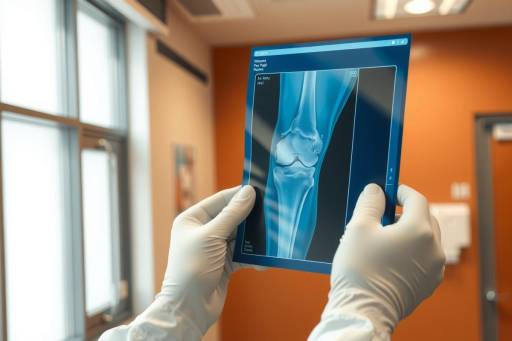
Alignment is central to osteotomy in a way it is not to partial replacement. The whole purpose of an HTO is to change the angle of the leg so weight passes through the healthier side. The AAOS explains that osteoarthritis can develop when the bones of the knee and leg do not line up properly, putting extra stress on one side. When a surgeon considers an osteotomy, they are looking for a deformity that is the source of the problem and that can be corrected. Surgeons plan this using specially aligned X-rays and software, according to the AAOS.
Age, body weight and activity
This is where "younger patients" comes in. The AAOS states that knee osteotomy is most effective for thin, active patients under the age of 60. It describes good candidates as having pain on one side of the knee only, no pain under the kneecap, and pain brought on mostly by activity or by standing for long periods.
Age matters for a practical reason too. An osteotomy keeps your own knee, and after it heals the AAOS says there are no restrictions on physical activity, including high-impact exercise. For someone with decades of active life ahead, that is a real consideration. At the same time, the AAOS notes that, when performed in appropriate patients, modern partial knee replacements have shown excellent medium- and long-term survivorship in both younger and older patients. Age on its own does not rule either option in or out. Our guide on what age is best for knee replacement looks at age across all types of knee replacement.
How well the knee moves, and the state of the ligaments
Both operations need a knee that still moves reasonably well. The AAOS says osteotomy candidates should be able to fully straighten the knee and bend it to at least 90 degrees. For partial replacement, it says significant stiffness or ligament damage may make someone unsuitable, though they may still be a candidate for total knee replacement. Stiffness and ligament quality are judged with hands, not pictures. This is one of the reasons a remote opinion cannot settle the choice, as we explain in what a remote review can and cannot decide.
Conditions that change the picture
The AAOS notes that people with rheumatoid arthritis are not good candidates for osteotomy, and that inflammatory arthritis may make someone ineligible for partial knee replacement. Both operations rely on the rest of the knee staying healthy, and inflammatory arthritis tends to affect the whole joint. Our guide on knee replacement for rheumatoid arthritis vs osteoarthritis explains how the cause of arthritis shapes expectations.
The First Months: How Recovery Compares
The two recoveries feel very different, mainly because of one thing: after an osteotomy, a cut bone has to heal. The table below summarises the general picture described by the AAOS and the NHS. Your own plan will come from your surgical team.
| High tibial osteotomy | Partial knee replacement | |
|---|---|---|
| Typical hospital stay | Home 1 to 2 days after surgery in most cases | Home the same day or after an overnight stay |
| Weight on the leg | Crutches for several weeks; sometimes a brace or cast; the surgeon decides when weight-bearing can begin | Generally an easier rehabilitation than total knee replacement |
| What sets the pace | Bone healing, which takes about 6 weeks, checked with follow-up X-rays | Pain and swelling, which are usually less than after a total replacement |
| Return to full activity | About 3 to 6 months | Shorter recovery than total knee replacement, according to the NHS |
| Activity after recovery | No restrictions once healed, including high-impact exercise | Discussed individually with the surgeon |
Why the osteotomy recovery is slower
The AAOS is direct about this. Recovery from osteotomy is typically longer and more difficult because you may not be able to put weight on the operated leg straight away, and the bone needs about 6 weeks to heal. After a follow-up visit with X-rays, the surgeon tells you when it is safe to put weight on the leg and when rehabilitation can start.
For partial knee replacement, the AAOS lists quicker recovery, less pain after surgery, less blood loss and a lower risk of infection and blood clots among its advantages over total knee replacement. It also reports that many patients say a partial replacement feels more natural than a total replacement.
What the difference means for work and travel
The recovery gap between a high tibial osteotomy and a partial replacement has knock-on effects that are easy to underestimate:
- Time off work. Several weeks on crutches matters more for someone whose job involves standing, walking or driving. For comparison, see how long people usually take to return to work after knee replacement.
- Help at home. Limited weight-bearing means more help with everyday tasks for longer.
- Travelling for surgery. If you have surgery in another country, the osteotomy timeline involves follow-up X-rays to check healing, and those may happen after you are home. You would need to know in advance who will take and review them, and how the results get back to your surgeon. Travelling home on crutches also needs planning.
Life with a partial replacement after full recovery, including sport, is a separate conversation. Our guide on returning to sports after knee replacement explains how surgeons assess this.
Pain relief is not equally predictable
One more difference belongs here. The AAOS says pain relief after osteotomy is not as predictable as after partial or total knee replacement. Osteotomy keeps your knee and leaves activity open, but its result is less certain. Partial replacement tends to give more predictable pain relief but adds an implant to the knee. That trade-off sits at the heart of the choice.
Get Support for Joint Pain and Osteoarthritis
Answer a few short questions and HealthNode will help you connect with the right orthopedics, physical therapy, or joint care specialist.
Pain and Daily Life
This helps us understand how much the joint problem affects your movement and daily activities.
Previous Diagnosis or Treatment
Tell us what has already been checked or tried so we can route you to the right care option.
Contact information
Your information is only used to contact you and is never shared with third parties.
Your request has been received!
Thank you. If you have X-ray, MRI, blood test results, previous diagnosis notes, medication history, injection records, physical therapy notes, or previous surgery records, please keep them ready. A HealthNode consultant will guide you through the next step.
When a Total Knee Replacement Comes Into the Picture
For many younger patients, the real question is not "which operation now?" but "which path for the next 20 or 30 years?" Both operations can be followed by a total knee replacement later, in different ways.
After an osteotomy
The AAOS describes osteotomy as a way to delay knee replacement, possibly for several years. It also notes that many patients will eventually need a total knee replacement. That is not a failure of the plan. For many younger people, delay is the plan.
There is a catch. The AAOS says that having had an osteotomy can sometimes make a later total knee replacement more challenging. The shape of the bone has been changed, and the plate and screws used to hold it may still be in place. Our guide on whether old plates or screws need to be removed during knee replacement explains how surgeons approach existing metalwork. If you ever need a knee replacement after an osteotomy, the records of that first operation will be valuable, so keep them.
After a partial replacement
The AAOS names the possible need for more surgery as the main disadvantage of partial knee replacement compared with total replacement. If arthritis develops in parts of the knee that were not replaced, a total knee replacement may be needed in the future. Replacing a partial implant with a total one is a form of revision surgery, which is covered in our guide to revision knee replacement.
A change of plan during the operation itself
This point is often missed. The AAOS explains that during a partial knee replacement, the surgeon looks at all three compartments to confirm that the damage really is limited to one area and that the ligaments are intact. If they decide a partial replacement is not right for the knee, they may perform a total knee replacement instead. This backup plan should be discussed with you before surgery so that you agree with it.
If you are having surgery abroad, ask how this possibility is written into your consent form and your price quote. Find out what changes in cost, hospital stay and recovery if the operation becomes a total knee replacement, so you are not deciding under pressure later. Our guide on the difference between partial and total knee replacement gives the background on what a switch would mean.
Comparing the Cost Over Years, Not Weeks
A price quote shows what one operation costs today. For a younger patient choosing between a high tibial osteotomy and a partial knee replacement, the more useful question is what each path is likely to cost over time. We do not give prices here, because they vary widely between countries, hospitals and individual cases. The structure of the costs is easier to compare.
What the operation itself includes
An osteotomy does not involve a joint implant. The surgeon fixes the bone with a plate and screws, and sometimes uses bone graft or synthetic bone, according to the AAOS. A partial knee replacement includes a metal and plastic implant, and the implant is part of the cost. For how partial and total replacements compare on price, see total knee replacement cost vs partial knee replacement cost.
The costs that come after the operation
This is where the gap can narrow or even reverse:
- Recovery time. The longer crutch period after osteotomy can mean more unpaid time off work, more help at home and more physiotherapy.
- Follow-up imaging. Checking that the bone has healed needs follow-up X-rays and appointments.
- A shorter stay. A partial replacement often means a shorter hospital stay, which matters most when you are paying for accommodation abroad as well as the hospital.
Our guide to what costs can continue after you return home from Turkey helps you list these.
The second operation that may or may not come
Both paths can lead to a total knee replacement later. For a younger patient that possibility is real enough to plan for. It is not a reason to choose one path over the other on cost alone, because no one can say whether or when it will happen. It is a reason to see today's quote as the first chapter rather than the whole budget. Our guide on whether you will need another knee replacement in the future covers the general picture.
What a written quote should make clear
Whichever operation is proposed, a clear written quote should state:
- exactly which operation is planned, and what happens to the price if it changes during surgery
- the expected number of nights in hospital, and the cost of extra nights
- which follow-up visits and X-rays are included, and which you will need to arrange at home
- the deposit, cancellation and rescheduling terms, explained in our guide to what your deposit and cancellation terms should specify
The choice between a high tibial osteotomy and a partial knee replacement comes down to your knee, your age and your plans, assessed by a surgeon who has examined you. If you would like Turkish orthopaedic teams to look at your case, HealthNode can help you share your scans and records and get a written opinion on which operation they would consider, along with a quote that spells out each of these points.